
 EN
EN
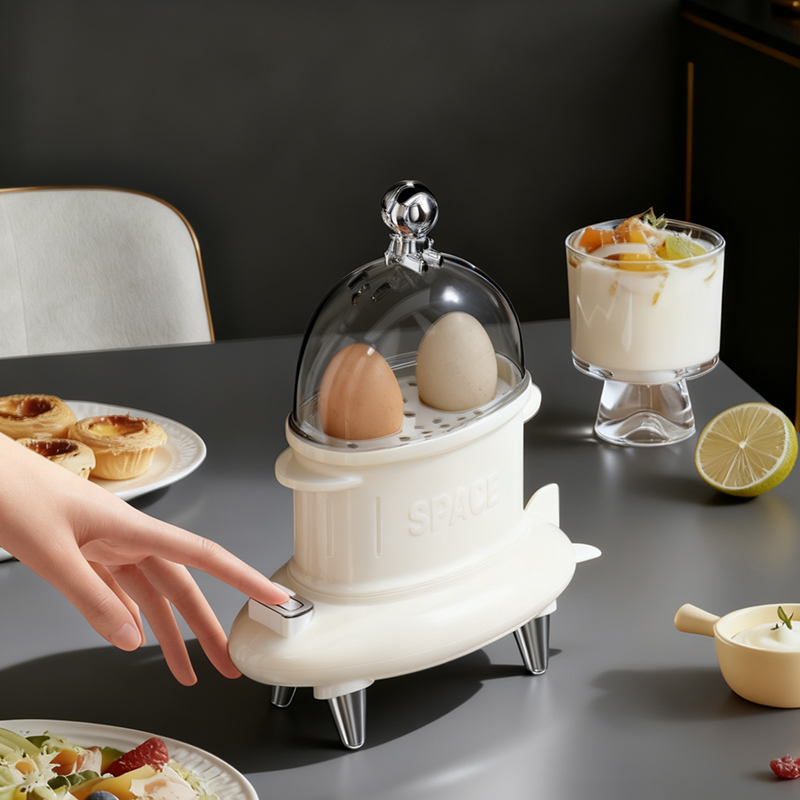
Electric Egg Boiler: The Science Behind Perfectly Cooked Eggs Every Time
Walk into any kitchen, and you will find at least one person who struggles with boiling eggs. The challenge is universal: one day the eggs peel perfectly with creamy, jammy yolks; the next day they are overdone with green-gray rings and rubbery whites—even though you swear you followed the exact same steps.
The difference is not in your technique. It is in the consistency of heat application. Here is the science behind why an electric egg boiler eliminates that variability—and how precise steam control delivers reliable results, batch after batch.
Why Steam Beats Boiling Water
The way heat reaches the egg is the fundamental difference between an egg boiler and a stovetop pot. Boiling water and steam transfer heat in fundamentally different ways.
How boiling water works:
-
Water boils at 100°C (212°F) at sea level
-
The egg is submerged in water, relying on direct contact conduction
-
Hot spots form at the base of the pot, leaving upper surfaces relatively cooler
-
Temperature swings occur as water cools upon egg immersion, then overheats as it returns to a rolling boil
How steam cooking works:
-
Steam surrounds each egg in a saturated vapor cloud
-
Condensation releases latent heat uniformly across the entire shell surface
-
The shell temperature stabilizes at approximately 87°C (189°F)—significantly lower than boiling water‘s 100°C
-
Condensed water drips back and re-vaporizes, recycling thermal energy
The key advantage: Lower shell temperature (≈87°C) slows protein denaturation, allowing heat to diffuse inward without overcooking outer layers. That is why soft-boiled eggs take 7–8 minutes in steam versus 4–5 minutes in boiling water—yet yield a more forgiving, uniformly tender texture.
From the field: A home cook I spoke with described her pre-boiler experience: “I would set a timer, but the eggs would come out different every time. I thought I was just bad at cooking eggs.” After switching to a steam-based egg boiler, she got perfect results on her first try. “Now I know it was never me—it was the inconsistent heat.”
The Science of Steam: Understanding Latent Heat
When steam condenses on a cooler egg shell, it releases what is called latent heat of vaporization. This is the same energy that was absorbed when the water was heated from liquid to vapor. When that vapor condenses back into liquid on the shell surface, that energy is released directly into the egg.
What this means in practice:
-
The heat transfer is omnidirectional—every part of the egg receives equal heat
-
The lower temperature (≈87°C at the shell) gives the yolk time to cook gently
-
Proteins in the white and yolk denature at different rates, allowing better texture control
This uniform, gentle heat is what gives steam-cooked eggs their characteristic consistency—no more rubbery whites or over-firm yolks.
Calibrated Water: The Key to Repeatable Doneness
The electric egg boiler’s calibrated water reservoir is the foundation of its precision. Clearly marked fill lines correspond to soft, medium, and hard doneness levels—each representing a specific, pre-validated volume of water designed to generate exactly the steam duration required for that outcome.
Why this matters:
| Doneness | Water Volume | Steam Duration | Internal Yolk Temperature |
|---|---|---|---|
| Soft-boiled | Smallest | Shortest | ~65–68°C (runny, jammy) |
| Medium-boiled | Medium | Medium | ~70–73°C (custard-like) |
| Hard-boiled | Largest | Longest | ~75–77°C (fully set) |
Temperature ranges based on USDA food science guidelines for egg yolk coagulation.
The precision requirement: Egg yolks coagulate within a narrow thermal window. Thickening begins at 65°C (149°F), and full firmness occurs between 70–77°C (158–170°F). Since steam duration is directly proportional to water volume, even a ±1 mL deviation alters cooking time by roughly 5–10 seconds—enough to shift internal egg temperature by 1–2°C.
That small change can push a soft-boiled egg into medium territory—or a medium egg into hard. The boiler’s reservoir markings are engineered to support measurement accuracy within ±0.5 mL, keeping steam time tightly constrained.
Auto-Shutoff: The Mechanism That Prevents Overcooking
The egg boiler‘s automation eliminates manual timing entirely. Its auto-shutoff system—driven by either a moisture-sensitive thermostat or a timer-based algorithm calibrated to water volume—detects the exact moment all water has converted to steam and terminates heating.
How it works:
-
The heating plate raises water to boiling point, generating steam
-
Steam envelops the eggs, cooking them gently and evenly
-
When the last of the water evaporates, the thermal sensor or bimetallic strip triggers shutoff
-
Power cuts off instantly—no guesswork, no overcooking
Why this matters: Once all water is vaporized, continued heating would rapidly raise the internal temperature, turning a soft-boiled egg hard in seconds. The auto-shutoff prevents this entirely.
This precision also aligns with USDA food safety recommendations, which specify an internal temperature of 71°C (160°F) for safe egg consumption to ensure pathogen reduction.
Three Simple Steps for Perfect Results
Even with intelligent automation, optimal performance depends on three simple but essential steps:
1. Prick the wider end of each egg
Use the included pin to prick the wider end of each egg. This releases air from the natural air cell, minimizing pressure buildup and preventing cracks while promoting uniform steam penetration. This simple step is the difference between a clean, intact egg and one that cracks during cooking.
2. Load eggs with the pricked end up
Place eggs with the pricked end facing up. Avoid overcrowding—the eggs need unobstructed steam flow around each shell for even cooking.
3. Seal the lid firmly
A tight seal maintains a fully enclosed steam chamber. Even minor leaks disrupt pressure and alter cooking time, compromising the calibrated water-to-steam conversion.
From the field: A user shared that she had been skipping the pricking step because it seemed unnecessary. “I had two cracked eggs in a row and could not figure out why. Turns out the air needed somewhere to go. Now I prick every time—and zero cracks.”
Real-World Impact: Consistency, Convenience, and Less Waste
| Aspect | Stovetop Boiling | Electric Egg Boiler | Improvement |
|---|---|---|---|
| Consistency | Variable (temperature swings) | Consistent (steam + auto-shutoff) | Reliable results every time |
| User Attention | Requires timer + monitoring | Set and forget | Hands-free operation |
| Overcooking Risk | High | Eliminated (auto-shutoff) | No more rubbery eggs |
| Peelability | Inconsistent | Consistent (gentle steam) | Clean peeling every time |
| Water Usage | 2–4 cups per batch | Precisely measured (mL) | Minimal waste |
Why this matters for the user:
-
No more standing over the stove watching a pot
-
No more setting a timer and still getting inconsistent results
-
No more eggs that are impossible to peel
-
No more wasted eggs from overcooking
From the field: A busy parent shared: “I make boiled eggs for my kids‘ lunches every week. I used to dread it because the results were unpredictable. Now I fill the reservoir, press the button, and come back 10 minutes later. Perfect eggs every time. It saves me at least 15 minutes a week.”
Why This Design Makes Sense
The electric egg boiler solves a problem that most people do not even realize they have—inconsistent heat application. By replacing the variables of stovetop cooking with a calibrated, automated system, it delivers results that are reliable, repeatable, and forgiving.
The key engineering insights:
-
Steam is gentler than boiling water – Lower shell temperature (≈87°C) prevents overcooking
-
Water volume controls steam duration – Calibrated measurements = predictable doneness
-
Auto-shutoff prevents overcooking – Power cuts the moment water is fully vaporized
-
Simple user steps ensure performance – Pricking, loading, and sealing are all it takes
FAQ
Why does the electric egg boiler use steam instead of boiling water?
Steam provides more uniform heat transfer because it condenses evenly on the egg shell, enabling consistent cooking. Boiling water can create hot spots and uneven heat distribution.
How does the auto-shutoff mechanism work?
The auto-shutoff system is triggered by either a moisture-sensitive thermostat or a timer-based algorithm. It stops heating the moment all water has been converted into steam, preventing overcooking.
Can small variations in water volume impact egg doneness?
Yes, even a ±1 mL variance in water volume can alter steam duration and cooking time, shifting egg doneness by 1–2°C, which is critical for achieving the desired yolk texture.
Why is it necessary to prick the eggs before cooking?
Pricking the eggs releases air from the natural air cell, minimizing pressure buildup, preventing cracks, and ensuring uniform steam penetration.
How do I achieve soft, medium, or hard-boiled eggs?
Use the calibrated fill lines on the reservoir—soft requires the least water, medium requires a middle amount, and hard requires the most. Each line corresponds to a pre-validated steam duration.